


Geology & History of the Gastein Healing Gallery
How it all began
Geological development
A series of successful geological processes over a considerable period of several million years was ultimately necessary to create the unique deposit of the natural noble gas radon at the far end of the Gastein Valley. Here you will find an overview of the processes in chronological order, presented graphically, and the path leading to the discovery and utilization of the underground source of today's successful medical applications in the Gastein Healing Gallery. This information is also available in the document "Model of the Geological Development of the Gastein Healing Gallery" – you are welcome to order the folder (in German) here.
Birth of a mountain and its brothers
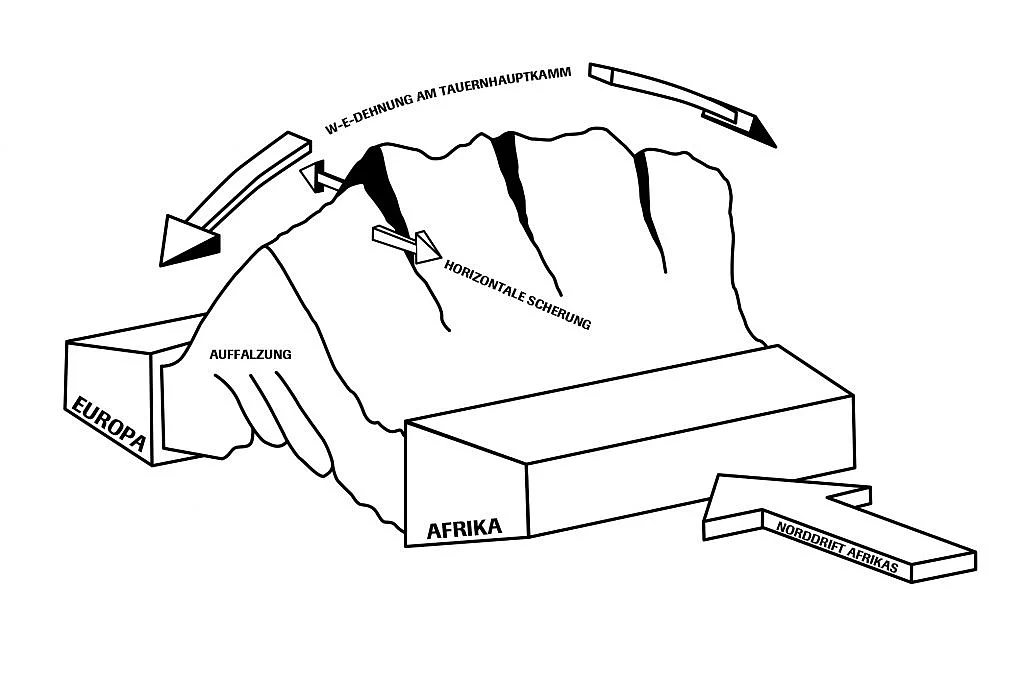
The rock deposited in the Pennine Ocean (the ancient Mediterranean Sea) between Europe and Africa prior to the formation of the Alps as a result of continental erosion could only escape the enormous pressure exerted by the northward thrust of Africa by rising upward (folding) and moving sideways (east and west). The resulting east-west stretching of the rocks created numerous north-south-oriented, steep faults, which cut the new mountain range into several sections at great depths. One of these rifts also divided the later Gastein Radhausberg mountain into two halves forever, which were also moved horizontally relative to each other. This rift ultimately formed the geological prerequisite for a massive mineralization process (hydrothermal sulfide mineralization) in the final phase of the Alpine orogeny.
Around 25 million years ago: A mountain becomes rich
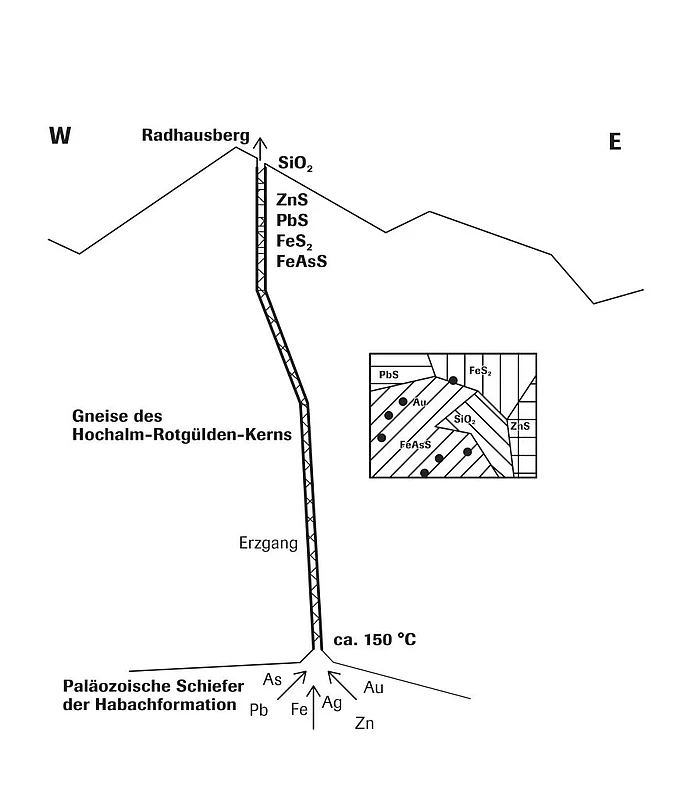
The great pressure from the weight of the overlying gneisses mobilizes non-ferrous metals from the underlying Paleozoic shales of the Habach Formation. The precious metals contained therein are pulled upward solely due to the existence of this deep fissure (zone of complete pressure relief), with the predominant transport medium being silicic acid (SiO2), which is also squeezed out of the rock. As the metal solutions rise, they cool and crystallize, filling the cavities of the vein fissures with ore. The outgassing of silicic acid in the uppermost areas leads to the formation of sulfide-rich quartz druses with isolated free gold crystals (glass ore).
One small thing was still missing...
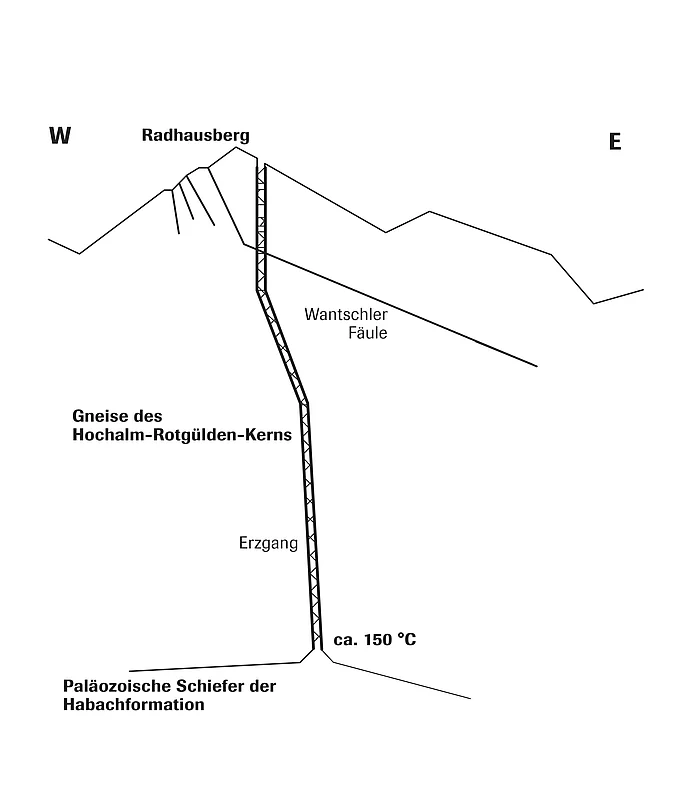
After mineralization was complete, the entire Radhausberg was torn apart a second time by the alpine mountain-building forces, which were now slowly coming to an end. This resulted in the formation of shallow relaxation fractures close to the surface in the gneiss, whose fracture surfaces were completely ground down by strong relative movements. The abrasion forms a fine-grained and largely watertight, clayey sediment in the fracture zones. Pressure and temperature are no longer sufficient for the possible migration of ores into these structures, which remain largely barren. (Miners would later refer to these structures as "foulings").
Around 10,000 years ago: Finally, it's getting warm...
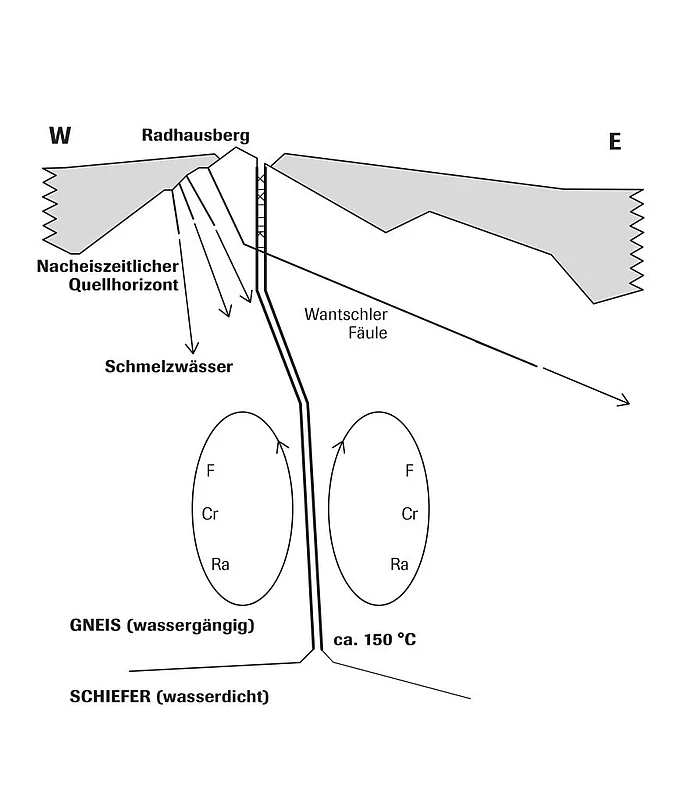
This was followed by a long period without any further significant geological events. It was not until the end of the last global glaciation about 10,000 years ago that the formation history of the Gastein healing springs continued. The melting of the kilometer-thick ice sheet quickly led to a huge supply of free surface water, which on the one hand began to slowly erode the flanks of the mountain, but on the other, especially along the western slopes, was relatively quickly diverted into the interior of the mountain. The porous gneiss can absorb large quantities of meltwater in this way and slowly channel it deep underground along its eastward-sloping schist surfaces. The underlying schist, on the other hand, forms a natural water barrier. The high rock temperature at great depths has time to take effect, the water warms up, reduces its specific weight, and thus rises again. As it rises, it cools down once more (decrease in rock temperature, mixing effects with cooler water flowing in, etc.), so that a large-scale cycle can eventually develop.
A major part of the meltwater is thus trapped in the gneisses of the Radhausberg for a long time and dissolves the trace elements it contains, such as radium, chromium, and fluorine. The metallic radium salts dissolved in the water decay into gaseous radon, but only after enrichment with fluorine salts can the waters attack and dissolve the metals in the ore vein. Suddenly, an excellent path emerges for the radon water to rise along the emptied vein back towards the surface. However, a layer of clayey sediments, which is insurmountable for the water rising from the depths, stops this process and protects the ore vein from further leaching.
At the same time, at the end of the Ice Age, the geometry of the mountain also begins to change significantly. The valley flanks are heavily eroded and deepened by the melting glaciers, so that the hot waters can now emerge and flow away via numerous springs, especially on the western flank. A first natural spring horizon forms, the remaining ore vein above it is saved from further leaching and is once again at rest.
Around 250 years ago: The greed for gold...
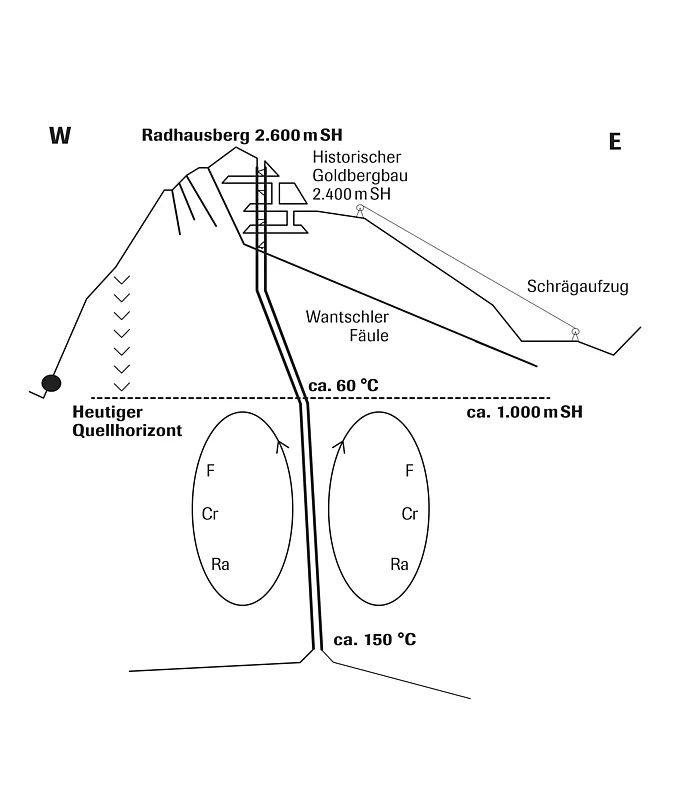
Several thousand years later. The Radhausberg has essentially taken on its present form. Further erosion of the valley flanks also causes the exit points of the thermal water (altitude of the springs) to sink steadily until the thermal water level in the mountain finally reaches its present height. The surface water that continues to seep in on the western flank of the mountain pushes the thermal water out of the springs, similar to a bucket filled to the brim and overflowing. This bucket was filled during the Ice Age, and its rim is the current spring horizon.
But the long period of rest for the residual ore vein is already over. Now that word has spread about the healing powers of the springs at the foot of its mountain, its rusty brown head (oxidized outcrop zone) is attracting numerous adventurers and miners to the valley, who are now going at the mountain and its precious metals from the surface. The vein defends itself with all its might (trapped mine water, harsh and long high-alpine winters, complicated ore transport, etc.) – but nevertheless: historical mining mercilessly snatches its treasures from depths of approx. 400 meters. Then the hand-operated technology of that time reaches its limits; further advancement into the depths is impossible, even though the precious metals continue to beckon. In some places, the miners had already reached the great decay zone, and they secretly puzzled why the rich ore suddenly came to an end here. While most seemed to attach little importance to the question, others were certain that the mineralization must continue deeper down.
Around 85 years ago: An almost perfect plan...
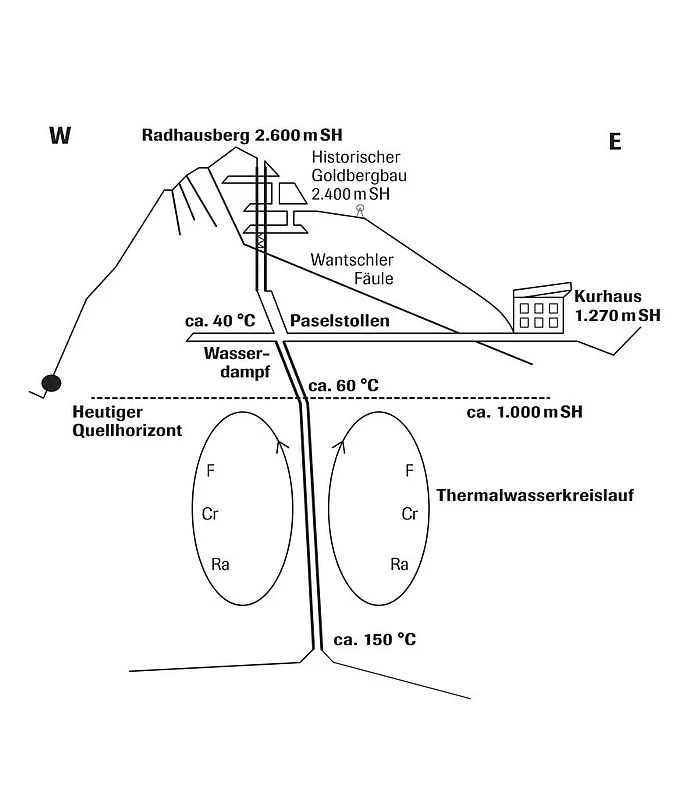
The Radhausberg and its treasures have now been annexed and are part of the German Reich. Using state-of-the-art technology, a new access tunnel to deeper sections of the ore vein is being driven from the eastern flank of the valley. This promising attempt, known as the Paselstollen, takes just under two years and, at the end of 1944, after 1,840 meters, actually reaches the ore vein approximately 400 meters below the historic mine.
However, the Berlin Reich Ministry of Economics at the time was greatly disappointed to learn that no ore could be found in the vein. Even a 120-meter-high excavation shaft in the vein revealed only empty, depleted cavities filled with hot steam, which had heated all the rock in its vicinity to over 40 °C. Shaking their heads, the German miners left this tunnel, which they considered worthless; once again, the mountain had prevailed.
It was not until the early 1950s that the radon content of the hot steam in the Paselstollen mine was discovered and the connection with the famous Gastein thermal springs was recognized.
...and today: Source of health
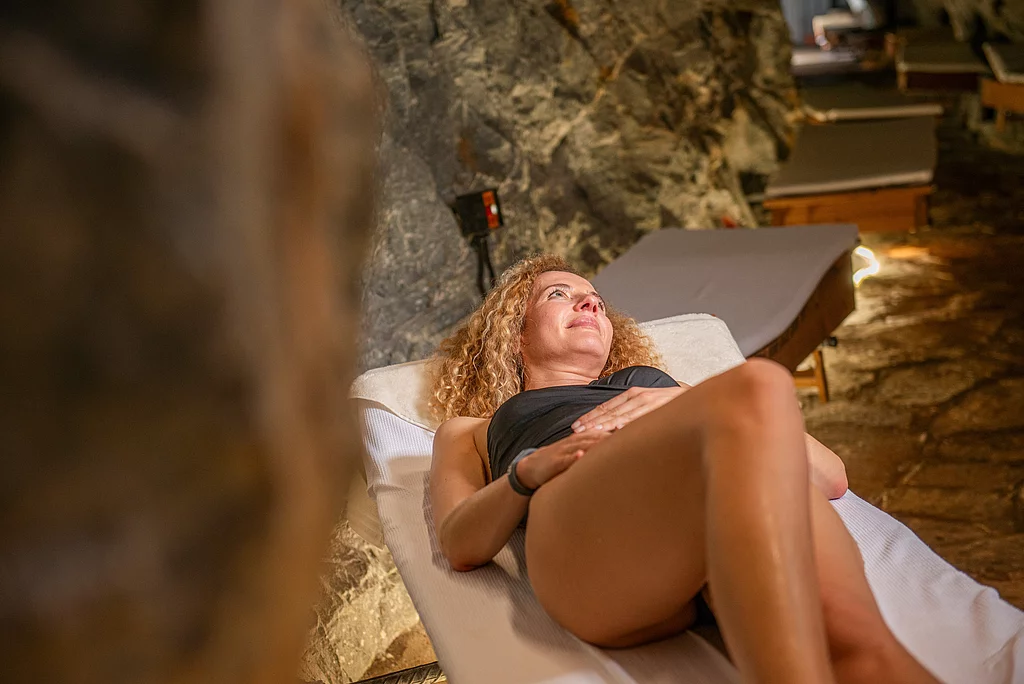
It was only natural to make the healing power of radon, which had been valued for centuries, available to patients in the tunnels. In 1952, the people of Gastein, in collaboration with the University Hospital of Innsbruck, established a unique healing facility here, the effects of which remain unsurpassed to this day. It has brought relief and alleviation to countless patients suffering from rheumatic complaints. People still remember the precious gold in the ore vein, small remnants of which may still be present in the area of the decay. But given its abundant treasure in the form of radon, the mountain has probably finally found the rest it so richly deserves. The patients who slumber in its warm belly from time to time certainly do not disturb it much, especially considering what the old giant has already gone through in its eventful history.
The path to becoming a health center unique worldwide
With the termination of gold mining at the end of May 1944, extensive research work began, lasting for years, under the direction of the then head of the Gastein Research Institute, Prof. Ferdinand Scheminzky. In 1951, an expert opinion by the boards of the University Hospital of Innsbruck and the Research Institute stated: “Treatment in the tunnel has a therapeutic value that is equivalent to that of spa treatments, but for a considerable number of suitable patients, it exceeds the therapeutic value of all previously used treatment methods, even the most modern ones.”
Anniversary books detailing the entire history of the cave are available at selected bookstores and in the Gastein Healing Gallery shop! (in German)